


We transform legacy communication systems into innovative, highly-adopted engagement platforms that support resident well-being and staff efficiency.


%20(14).png)
A single community can absorb a weak tool. Staff build workarounds, residents adjust, and a paper calendar or a phone tree limps along because there is only one of everything to manage.
Add a second campus, a new care level, or a ground-up build across town, and the weak tool stops limping and starts costing money. Every disconnected system multiplies. Staff retrain. Residents relearn. The experience that defined the flagship community thins out at exactly the moment leadership wants it carried forward intact.
Presbyterian Homes of Georgia, a Christian ministry serving senior adults since 1949, met that problem head-on and built a repeatable answer to it.
In 2015, Presbyterian Homes committed to its first Greenfield project in decades: Presbyterian Village Athens. CEO Alex Patterson faced the part of new construction that rarely makes the brochure. Lenders typically require a community to pre-sell about 70% of its units before releasing financing, and construction can run two full years. That meant holding the attention of hundreds of future residents across a long window — with nothing physical to show them and contracts they could walk away from.
The existing tool was a single-blast phone system. It pushed announcements in one direction. It could not carry a relationship across two years.
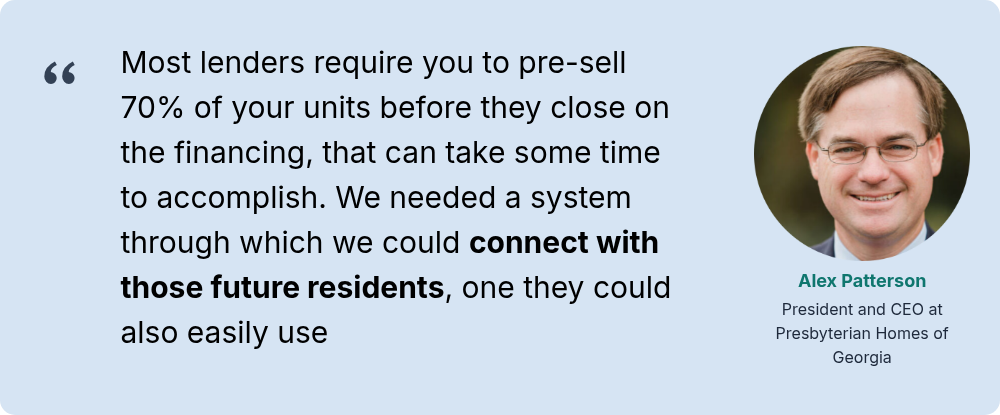
Presbyterian Homes chose Wellzesta as its resident engagement platform after a resident technology committee — including IT-oriented University of Georgia faculty living on campus — evaluated competing systems and picked the one residents could use without training. In Alex Patterson's words, it was the option that "rose to the top," which to him simply meant it was intuitive.
That choice mattered more with every campus that followed. A platform that works in one building and stalls in the next is not a platform; it is a pilot. The real test is whether the second deployment is easier than the first.
For Presbyterian Homes, it was. The same rollout pattern that launched Athens carried into Presbyterian Village Cobb — a community that opened in 1987 and had layered in technology piecemeal for decades. "Same story over there," Alex said. One playbook, repeated.
Adoption is where engagement technology usually dies quietly: a launch, a handful of curious residents, and a year later nobody opens it. Presbyterian Homes shows the opposite pattern, on both ends of the building-age spectrum.
At Presbyterian Village Athens, five years after launch:
At the Cobb campus, modernized onto the same platform after Athens, the numbers match or beat the Greenfield site:
High adoption is what makes expansion worth doing. Rolling out a platform nobody uses only multiplies a failure. Rolling out one residents reach for every day compounds a win across every new door the operator opens.
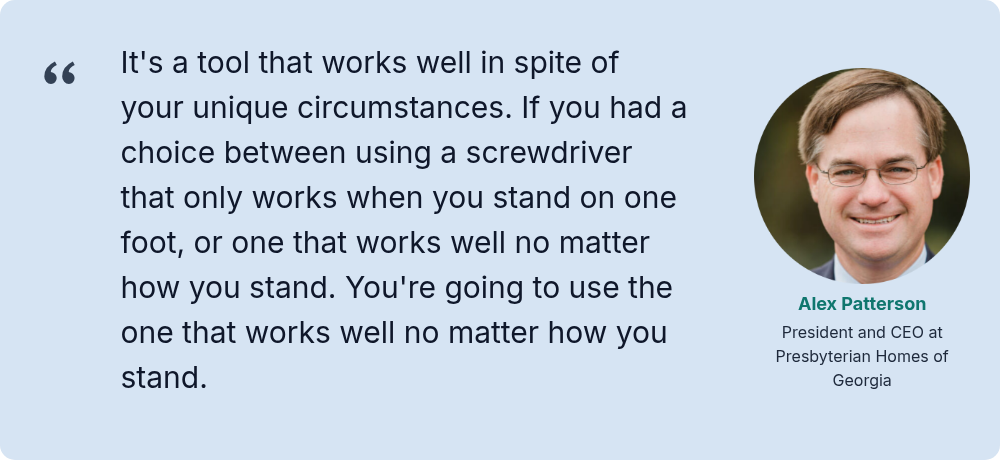
For operators building new communities, engagement is not only a quality-of-life metric, it is a financing reality. The 70% pre-sale threshold and the multi-year construction window mean depositors have to stay committed long before they have a home to move into. Every depositor who walks away is one the organization has to re-acquire at real cost.
Alex Patterson reports, "At Presbyterian Village Athens, we reasoned that the platform would make the organization 'seem cooler,' signaling that the campus was modern, not 'some Humpty Dumpty old school thing.' In concrete terms, we assumed that Wellzesta would reduce depositor attrition by 30% during the construction window; this assumption proved to be correct."
The reduction in attrition saved Presbyterian Homes significant cost in re-acquiring depositors who would otherwise have walked. For a CEO weighing the ROI of a multi-year build, depositor retention is not a soft benefit. It is risk reduction.
The proof is not retrospective. Presbyterian Homes is carrying the same platform into its new Oconee campus, currently in pre-sales. The system that held the original community together through two years of waiting is already in place for the next one and the ministry is extending it across the continuum into assisted living and skilled nursing, keeping residents connected as they move between care levels rather than disconnecting them when connection matters most.
The lesson is not that one community adopted software. It is that the right resident engagement platform earns the right to scale and proves it in the adoption data before you bet a new building on it.
If you are planning expansion — a new care level, a second campus, a Greenfield build — ask one question: will the tools you use today survive being copied? If the honest answer is no, the time to fix it is before the next site, not after.
Wellzesta is a resident engagement platform built for senior living communities. Founded in 2014 and headquartered in Greenville, South Carolina, Wellzesta supports communities across the independent living, assisted living, and memory care continuum. Learn more at wellzesta.com.
We transform legacy communication systems into innovative, highly-adopted engagement platforms that support resident well-being and staff efficiency.